How Rooted History works
Start free with your family tree, then choose the ancestors whose lives you want to understand more deeply.
From your tree to one ancestor’s life
1. Connect your family
Sign in and sync your FamilySearch tree to start exploring your family.
2. Explore and ask
Discover insights by era, geography, and data quality, or ask a natural-language Investigation question.
3. Choose an ancestor
Open any ancestor’s record and choose whose life you want to understand more deeply.
4. Create an Ancestor Chronicle
An Ancestor Chronicle tells the full story of that person’s life.
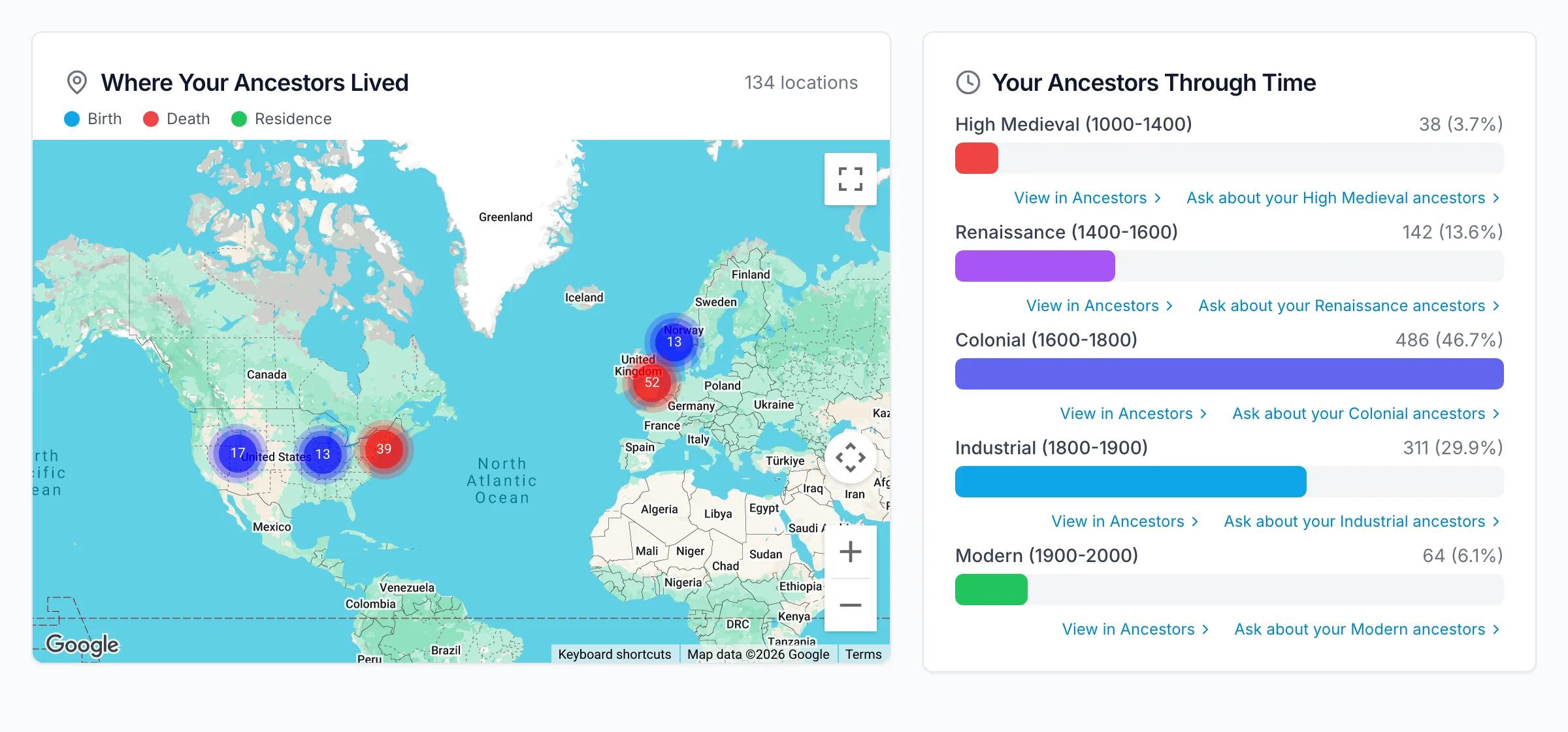
See your family across time and place
See your ancestors on a world map and across every era. Explore also points out missing dates and records that don’t add up.
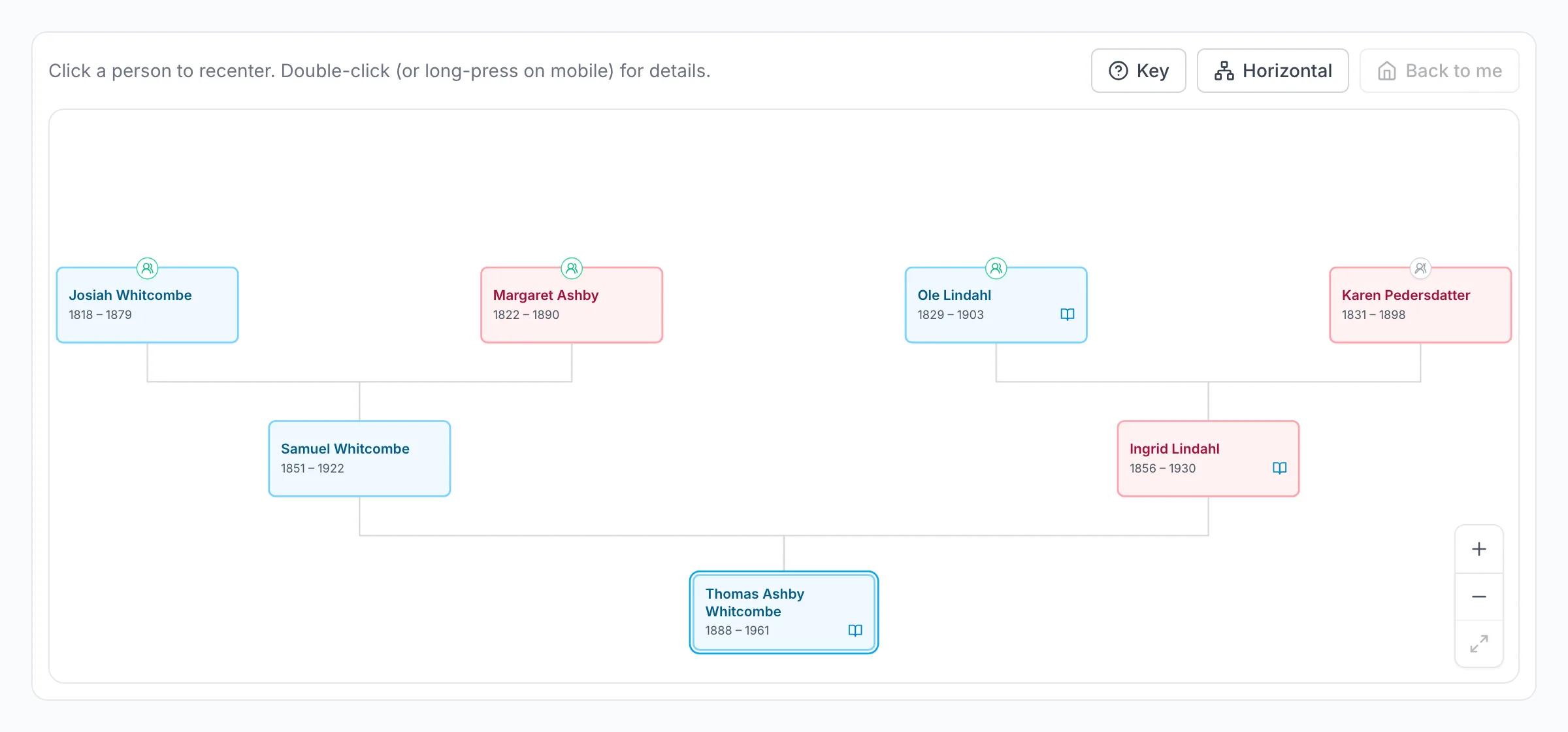
Navigate your family tree
Follow your direct line one generation at a time. Click any ancestor to move to them and open their details. You can also see who appears more than once and where a line ends.
Ask questions across your whole tree
Free, up to 20 questions a dayAsk a question in your own words, and Rooted History searches across your family tree to find the people, patterns and stories that help answer it.
For example
- “Who in my family was alive in America in 1776?”
- “Who was the youngest person in my family to get married?”
- “What occupations appear most often in my tree?”
- “Did any of my ancestors serve in the Revolutionary War?”
You ask naturally
Ask about people, places, patterns or events in your family history.
We search your tree
Rooted History searches the records already connected to your family tree.
We explain what we found
You get the people who match, what the records show, and the historical context that helps explain it.
An Ancestor Chronicle you can check
We gather the records
We start with your ancestor's records, family relationships, sources and life sketches, and flag places where the records disagree.
We write the story
We turn those records into a full life story, including the family and events that shaped it.
We check it twice
Every fact is checked against your records, then the writing is edited without changing the facts.
We label every sentence
We show what came from the records, what came from historical sources, and where the Chronicle is reasoning from the available evidence.
Historical Perspectives
Explore parts of your ancestor's world: daily life, faith, work, politics, education, technology and more.
Read it your way
Read the Original, switch to Relaxed Reading or For Kids, or listen to the story aloud.
How we show where the story comes from
Every sentence shows what it's based on, so you can judge the story for yourself.
- From the record
- A fact from your ancestor's genealogical records: names, dates, places, relationships and life events.
- Sourced history
- Historical context checked against outside sources. Tap the number to see the source.
- Our reasoning
- An interpretation based on the available evidence, clearly marked as reasoning.
- Background
- General history of the time and place, not tied to a specific source.
- Historians disagree
- Where reputable sources disagree, the Chronicle shows the different positions instead of quietly picking one.
Ready to Meet Your Ancestors?
Ancestor Chronicles start at $49.
Sign In with FamilySearchBuilt on FamilySearch records80 languages
Questions? Check out our Help & FAQ or see examples.